 l'administration


How To Measure For Sofa Covers & Avoid Costly Errors
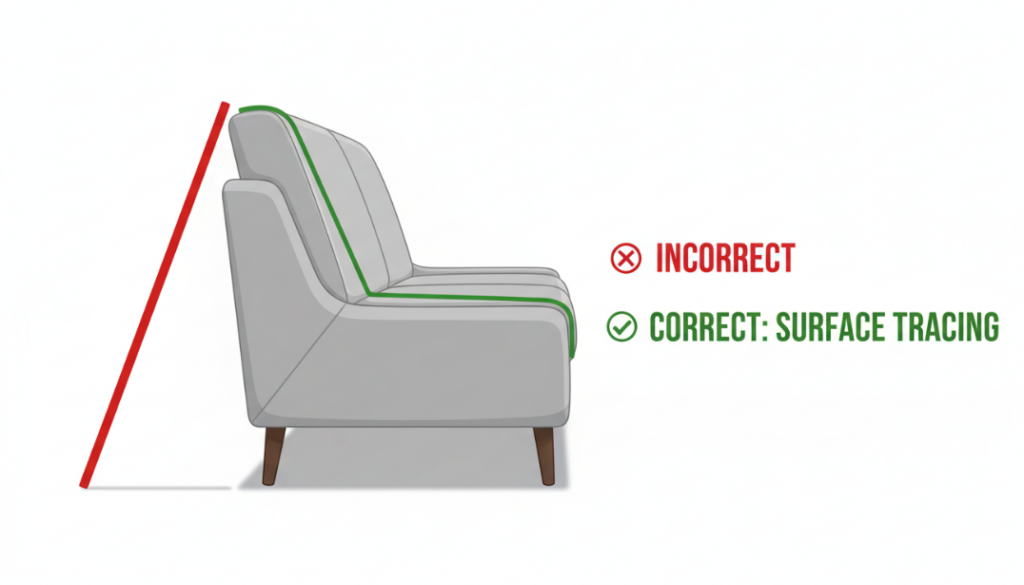
To accurately measure for a sofa cover, you must record the maximum outer width (from the outside of one armrest to the other), the exact surface contour from the seat cushion over the armrests, and the total backrest height starting from the floor. Relying on standard straight-line measurements causes a 40% return rate for online sofa cover purchases. Most buyers measure empty space instead of the actual path the fabric will follow. I have spent a decade testing slipcovers and analyzing return data. The problem is never the manufacturer’s size chart. The problem is how buyers handle a measuring tape around curved furniture. I will show you the exact surface-tracing method professionals use to guarantee a flawless fit, eliminating the risk of return shipping fees and wasted time.
The Standard “Length x Width” Method Fails: Here is Why
Traditional measurement guides treat your sofa like a wooden box. Sofas are soft, compressed structures that change shape over time. A straight line from point A to point B ignores the fabric tension required to cover padded armrests and sunken cushions. When you order a couch slipcover based solely on geometric width and height, the fabric bridges across the gaps. Sitting on that tight fabric instantly snaps the seams or pops the cover off the corners.
The AR Measurement App Trap
Using smartphone AR apps (like the iOS Measure app) guarantees a mismatched cover. LiDAR technology bounces light off the furthest protruding points of your couch. It registers the absolute outermost boundaries, completely ignoring the soft depressions, the tuck-in gaps behind the seat cushions, and the inward curve of Lawson or tuxedo armrests. AR gives you the dimensions of a shipping crate that could hold your sofa. You need the dimensions of the fabric skin that will hug it. Always use a soft tailor’s tape measure.
The Cushion Compression Reality
Old foam flattens and pushes outward. A three-seater couch bought five years ago has a different footprint today than its original factory tag claims. The front edge of the seat cushions likely protrudes an extra inch. Measuring the hard wooden base frame at the bottom ignores this cushion overhang. The cover will fit the bottom but stretch dangerously thin over the seating area.
The S.T.P. (Surface-Trace Protocol): 3 Steps to a Perfect Fit
The Surface-Trace Protocol (S.T.P.) forces you to measure the exact physical path the slipcover will take. You do not measure empty air. You measure the surface.
Step 1: Track the Maximum Outer Span
Find the widest points of your sofa, which are usually the outside edges of the rolled armrests. Pin the start of your soft tape measure to the outer edge of the left arm. Pull the tape across the front of the sofa to the exact opposite edge of the right arm. Do not pull the tape tight across the seating gap. Push the tape down so it touches the seat cushions the entire way across. This accounts for the extra fabric needed to bridge the dip between the two arms.
Step 2: Map the Inside Armrest Contour
Measure the specific fabric path over the armrest to prevent the cover from hovering above the seat. Start the tape measure at the floor on the outside of the right arm. Run it straight up the outside panel, over the curved top, down the inside of the armrest, and stop exactly where the armrest meets the seat cushion. Record this number. Repeat this for the backrest. Start at the back floor, run the tape up the back panel, over the top rim, down the front of the back cushion, and stop at the seat crease.
Step 3: Calculate the Deepest Seat Drop
Measure the seat depth by focusing on the maximum overhang. Start at the crease where the back cushion meets the seat. Run the tape forward, over the front edge of the seat cushion, and straight down to the floor. If your sofa has T-cushions that wrap around the front of the armrests, take this measurement at the widest part of the “T” shape to ensure the cover has enough front-panel material.
Adjusting Measurements Based on Fabric Elasticity
The material of your chosen sofa cover dictates how strictly you must follow your recorded numbers. A heavy cotton canvas requires pinpoint accuracy. A high-spandex blend forgives sloppy measuring.
If you buy a high-stretch cover (usually containing 15% to 20% spandex), you can safely round down your measurements by 1 to 2 inches. The tension keeps the cover looking custom-fitted. If you buy a non-stretch slipcover (like pure linen or denim), add exactly 1.5 inches to your final S.T.P. measurements. Non-stretch fabrics require physical slack to allow the material to flex when a person sits down. Without that 1.5-inch allowance, the metal zippers will burst under the sudden stress of human body weight.
How to Measure Complex L-Shaped and Sectional Sofas
L-shaped sectionals require you to treat the furniture as two completely separate sofas. Manufacturers rarely sell single-piece covers for sectionals because the corner tension destroys the fabric.
Locate the seam where the chaise lounge attaches to the main loveseat. Measure the main loveseat unit using the S.T.P. method, treating the open attachment side as a flat drop to the floor. Next, measure the chaise section entirely independently. For the chaise length, start at the backrest top, trace down to the seat, run the tape all the way to the foot edge, and drop it to the floor. You will purchase two separate slipcovers—typically one “3-seater” size and one “chaise” size. Match the total lengths of each distinct piece to the sizing chart.
Frequently Asked Questions (People Also Ask)
How do I know if my sofa is a 2 seater or 3 seater?
Base this strictly on the total outer span measurement, not the number of seat cushions. Many modern sofas feature two extra-wide seat cushions but measure over 85 inches in length. Any sofa measuring between 58 and 73 inches wide is typically classed as a 2-seater (loveseat). Anything from 74 to 96 inches requires a 3-seater cover.
Should I measure the sofa with or without the cushions?
Measure the sofa exactly as it looks when you sit on it. Leave all fixed and loose seat cushions in place. The slipcover must stretch over the existing bulk of the cushions. Removing them during measurement guarantees the final cover will be drastically too small.
How do you measure for a couch cover with T-cushions?
Measure the absolute widest point of the “T” shape at the front of the sofa. Do not measure the narrower width near the backrest. The cover needs enough fabric diameter to slip over those protruding front corners without ripping.
Do universal sofa covers really fit all shapes?
No universal cover fits every shape perfectly. High-spandex covers can conform to basic square or Lawson-style couches. They struggle with rolled English arms or heavily tufted Chesterfield sofas, often creating a “trampoline effect” where the fabric stretches tight across deep gaps instead of tucking into the crevices.
How much extra fabric should I allow for tucking?
You do not need to calculate extra tucking fabric if you use a high-stretch spandex cover, as the material naturally expands into the creases. For non-stretch woven covers, add a minimum of 4 inches to your total width and depth measurements. This surplus is physically pushed deep into the seat crevices using foam tucking rollers to lock the cover in place.